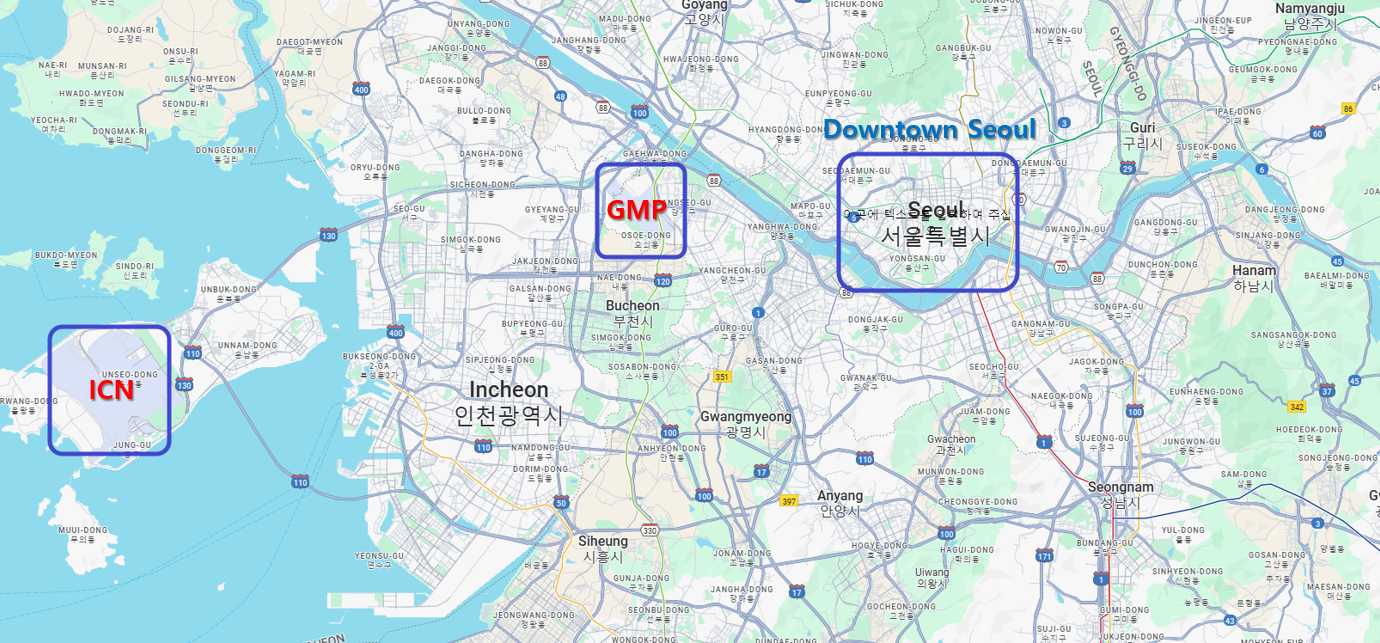
When planning a trip to Seoul, one of the first questions many travelers face is: “Should I fly into Incheon International Airport (ICN) or Gimpo International Airport (GMP)?”
Your choice of airport can make a big difference in terms of travel time, convenience, and even airfare. This guide provides updated 2025 information to help you decide which airport best suits your itinerary.
Incheon (ICN) vs. Gimpo (GMP): Understanding the Difference
Seoul is served by two main airports: Incheon International Airport (ICN) and Gimpo International Airport (GMP).
Incheon (ICN) is the largest and busiest airport in Korea, handling most international flights from around the world.
Gimpo (GMP), located closer to central Seoul, mainly handles domestic routes and a few short-haul international flights to Japan and China.
So, which is better for your Seoul trip — Incheon or Gimpo? Let’s compare them in detail.
Incheon International Airport (ICN)
Global Connectivity
Incheon Airport (ICN) is Korea’s primary gateway for international travel. It offers extensive flight connections across Asia, Europe, the Americas, and the Middle East.
If you are arriving from a long-haul destination such as the U.S., Europe, or Australia, your flight will almost certainly land at ICN.
Transportation to Seoul
Despite being located about 50 kilometers from central Seoul, Incheon Airport (ICN) is very well-connected.
You can take the AREX express train, which reaches Seoul Station in about 43 minutes, or use airport limousine buses, taxis, or private transfers.
Public transportation is punctual and efficient, making it easy to reach major districts like Myeongdong, Hongdae, and Gangnam.
Passenger Volume and Processing Time
As Korea’s busiest airport, Incheon can get crowded, particularly during holidays or weekends.
Allow extra time for check-in, security, and immigration — around 2 to 3 hours for international departures. However, ICN’s facilities are modern, comfortable, and well-organized, so even long waits are manageable.
Reliability and Infrastructure
Incheon Airport (ICN) is known for its reliability, safety, and service quality. It consistently ranks among the world’s best airports, offering state-of-the-art terminals, efficient flight management, and extensive amenities.
Ideal for:
- Long-haul international arrivals
- Travelers needing diverse flight options
- Those connecting through multiple destinations
Gimpo International Airport (GMP)
Closer to Downtown Seoul
Gimpo Airport (GMP) is located in the western part of Seoul, just 16 kilometers from the city center.
It takes about 25–30 minutes by subway or 20–40 minutes by taxi, depending on traffic.
This proximity makes GMP ideal for business travelers or those with short trips focused on Seoul.
Limited International Flights
Most flights at Gimpo are domestic, connecting Seoul to cities such as Busan, Jeju, Daegu, and Gwangju.
However, several short-haul international routes operate to Tokyo (Haneda), Osaka (Kansai), Shanghai, and Beijing, mainly serving regional travelers.
Less Congested and Easier Navigation
Because of its smaller size, Gimpo Airport (GMP) generally offers a smoother and faster airport experience.
Check-in and security lines tend to be shorter, and the terminals are easier to navigate — perfect for those who value efficiency over luxury.
Potential Limitations
Gimpo’s limited route network means fewer direct flight options from abroad.
If your departure city doesn’t offer a direct flight to GMP, you might need to transfer through another airport, often Incheon (ICN) or a hub in Japan or China.
Ideal for:
- Travelers from nearby countries (Japan, China)
- Domestic connections within Korea
- Visitors prioritizing short transfers to central Seoul
Key Factors to Consider
1. Flight Availability
If you’re flying from Europe, North America, or the Middle East, Incheon (ICN) is your only option.
For travelers from Japan or nearby regions, Gimpo (GMP) may offer convenient short-haul routes.
2. Travel Time to the City
Gimpo (GMP) is much closer to Seoul, saving up to an hour of travel time compared to Incheon (ICN).
However, ICN’s express train and limousine buses reduce this gap considerably.
3. Check-in and Security Wait Times
Incheon’s larger passenger volume can lead to longer queues, while Gimpo’s smaller size generally means shorter waits.
4. Price and Airline Options
Incheon (ICN) offers more airlines and competitive ticket prices thanks to higher traffic and international carriers.
Gimpo (GMP) may have higher prices or limited schedules due to fewer international flights.
5. Airport Comfort and Services
Incheon boasts high-end lounges, duty-free shops, cultural exhibits, and transit hotels.
Gimpo, while smaller, offers quick access, clean facilities, and convenience for short-haul travelers.
Which Airport Should You Choose?
- Choose Incheon (ICN) if you’re coming from a long-haul international destination or need flexible flight times and global connections.
- Choose Gimpo (GMP) if you’re arriving from nearby Asian cities or want to reach central Seoul as quickly as possible.
- For domestic travel, Gimpo (GMP) is almost always the preferred airport.
Both airports are modern, efficient, and foreigner-friendly. The right choice ultimately depends on your departure city, flight availability, and how much you value convenience versus variety.
Final Thoughts
When traveling to Seoul, deciding between Incheon (ICN) and Gimpo (GMP) comes down to balancing flight options, distance, and personal priorities.
Most first-time visitors arrive via Incheon International Airport (ICN) due to its wide range of flights and top-notch facilities.
However, frequent visitors and regional travelers often prefer Gimpo (GMP) for its unbeatable proximity to the city.
No matter which you choose, both airports provide a smooth, welcoming introduction to South Korea — ensuring your journey to Seoul begins and ends with comfort and efficiency.